
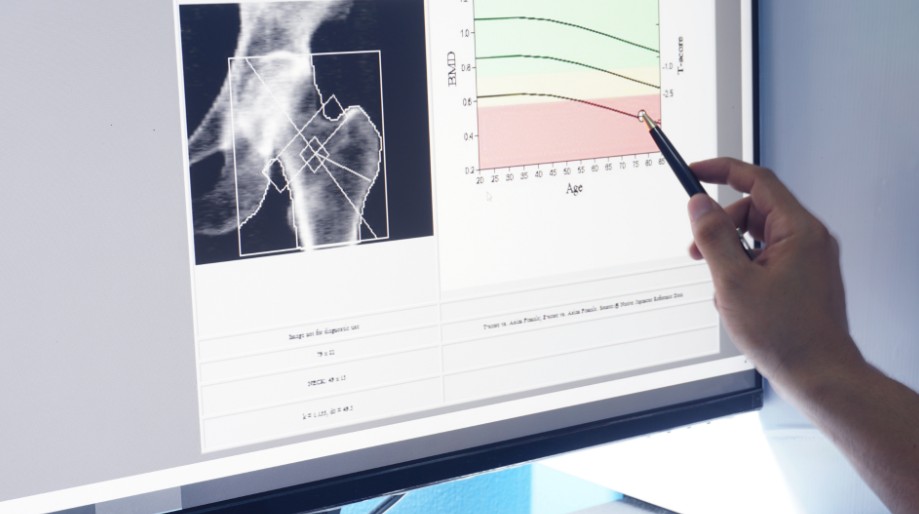
Bone strength often declines quietly for years before a fracture brings it to light. A quick, low-radiation DEXA scan can show where you stand today and what to do next.
Now is a timely moment to learn about women’s bone health and screening options. If you are in Ada, East Grand Rapids, Forest Hills, or the Greater Grand Rapids area, you can schedule a bone density assessment or ask about our Medical Baseline Special, which bundles a consult, comprehensive labs, and a DEXA scan.
This guide explains who should consider a DEXA scan, how to understand T-scores vs. Z-scores, what to expect at the appointment and how to prepare for your DEXA Scan You will also find the next steps if your results show osteopenia or osteoporosis.
What a DEXA scan measures and why it matters
A DEXA scan uses a very low-dose X-ray to measure bone mineral density (BMD). It typically focuses on the lumbar spine and hip, which are areas most predictive of fracture risk. At GenAge Center, we also provide body composition with DEXA when appropriate, which helps guide strength, protein, and lifestyle planning.
Results are reported as:
- T-score: Your BMD compared to a healthy young adult reference (20 – 29 year olds). Osteopenia is usually defined between -1.0 and -2.5. Osteoporosis is typically -2.5 or below.
- Z-score: Your BMD compared to people your age and gender. Z-scores can help uncover secondary causes of low bone density, especially in premenopausal women and andropausal men.
Who should consider bone density screening?
Women:
Traditional guidelines are for women 65 and older; however, bone density issues can occur at any age. Some examples are those with smaller bone structure, nutritional factors can play a role, exercise or lack-there-of can play a role, family history, and other unique factors that do not fall under the traditional guidelines. Long-term corticosteroid use, certain endocrine or GI conditions, or low body weight, early menopause, prolonged amenorrhea, or a significant family history of osteoporosis can also play a role in low bone density.
Men:
Traditional guidelines for men start 70 and older; however, like women, smaller bone structure, nutritional factors can play a role, exercise or lack-there-of can play a role, family history, and other unique factors that do not fall under the traditional guidelines. Long-term corticosteroid use, certain endocrine or GI conditions, or low body weight can also play a role in low bone density.
Athletes:
Athletes and people focused on long-term health also use DEXA to establish a baseline and track trends, not only for bone density, but for full body composition. If you are unsure whether you qualify, or would like to establish a baseline, our team can review your history and, when appropriate, help document data changes in your body composition.
Insurance basics and referrals
Coverage can vary by plan. Here is what to know:
Insurance coverage:
Many insurers cover a medically necessary DEXA bone density test based on age or risk factors, but preventive coverage details differ. It is best to check your specific benefits for bone density screening and any frequency limits.
Costs:
Cash prices for a DEXA scan vary by region and clinic. At the GenAge Center, our DEXA scan cost is $200 per scan and those using DEXA scans to track progress, can join the GenAge DEXA Club for a discounted rate on DEXA scans. Prices can change, so call to confirm current rates.
Referral needs:
Some plans or imaging centers require a referral for bone density testing. Others allow you to schedule directly. At the GenAge Center, you can self-refer for DEXA-based body composition testing and bone density.
If you are local and considering a scan, learn more about our DEXA services in Grand Rapids on our website: https://www.genagecenter.com/dexa-body-composition/
To learn about physician-led wellness memberships check out: https://www.genagecenter.com/membership-packages/
How to prepare for your appointment
A few small steps make the scan smooth and accurate:
- Do not take calcium supplements for 24 hours before your bone density scan. High calcium intake can affect results.
- Wear clothing without metal. Skip zippers, belts, snaps, and underwire. Soft, comfortable layers work well.
- Tell your clinician if you recently had contrast imaging. You may need to wait before DEXA scanning.
The scan itself is painless and typically takes 10 to 15 minutes. You will lie still on a padded table while the scanner passes over your spine and hip. Our technician will always explain each step and answer any questions.
Interpreting results and what to do next
If your T-score shows osteopenia or osteoporosis, you have many options to slow bone loss and lower fracture risk. Plans are individualized, but several strategies are consistently helpful:
Strength training:
Prioritize progressive resistance training 2 to 3 times per week. Focus on major muscle groups and hip-spine loading within safe limits.
Protein and nutrition:
Aim for adequate protein distributed across meals, plus calcium and vitamin D from food and supplements as recommended. Our nutrition team can help you translate targets into practical meals.
Lifestyle foundations:
Avoid smoking, moderate alcohol, fall-proof your home, and get regular outdoor walks for balance and bone-loading stimulus.
Medication options:
Depending on fracture risk and your T-score, your clinician may discuss medications that slow bone breakdown or build bone. Decisions are considered based on your history, other medications, and lab results.
Hormone considerations:
For women near menopause with vasomotor symptoms and bone loss risk, Hormone Replacement Therapy (HRT) may be part of a broader plan after a personalized risk-benefit discussion. For men with confirmed hypogonadism, testosterone therapy may also be considered with appropriate testing and monitoring.
At GenAge Center, assessments often start with a consult, labs, and DEXA. If hormones are part of the picture, our clinicians discuss whether HRT is appropriate, outline monitoring, and pair medical care with strength and nutrition support.
If you are interested in comprehensive weight and nutrition guidance that aligns with stronger bones and healthier lean mass, our physician-led programs can help you set protein targets and build muscle with accountability. Learn more about our Grand Rapids weight programs here: https://www.genagecenter.com/weight-loss/
If you live near Ada or Greater Grand Rapids, schedule a bone density assessment or ask about our Hormone Baseline Special, which includes a consultation, comprehensive labs, and a DEXA scan. Call 616-737-1710 or visit our DEXA page to get started: https://www.genagecenter.com/dexa-body-composition/
Quick FAQ
- Does insurance cover a DEXA body scan? Coverage often applies when the scan is medically necessary based on age or risk factors, but specifics vary by plan. Call your insurer to confirm benefits and any frequency limits.
- How much does a DEXA scan usually cost? Cash prices vary by region. At GenAge, DEXA scan standard pricing is $200, prices may vary. Please call to confirm current pricing and ask about seasonal discounts.
- Do I need a referral for a DEXA scan? Some insurers and imaging centers require it. Others do not. We can help determine whether your situation meets medical-necessity criteria and coordinate documentation or referrals if needed.
- Can I self-refer for a DEXA scan? You can self-refer at GenAge Center for DEXA body composition testing. For bone density scans used to inform diagnosis or treatment decisions, we review your history and assist with medical-necessity documentation and referrals when appropriate.
- What should you never do before getting a DEXA bone scan? Avoid calcium supplements for 24 hours before the scan. Also, wear clothing without metal to prevent image artifacts.
Summary and next steps
Bone health is measurable, improvable, and worth your attention. A DEXA scan clarifies your current bone density, helps you understand T-scores vs. Z-scores, and guides targeted steps, from strength training and nutrition to medications and, when appropriate, HRT. If you are in the Grand Rapids area, this is a great time to schedule a bone density assessment or ask about our Hormone Baseline Special. Call 616-737-1710 or visit our DEXA page to book.


